The practical answer.
Identify the applicable finished-product requirements before approving a coin cell holder or enclosure. Review how the battery is retained and accessed with the production enclosure fitted, then coordinate the compartment tests, marking and documentation with the team responsible for the device and its destination market.
- Review the cell, holder and enclosure as one installed assembly.
- Treat replaceable and internal battery designs as distinct service paths.
- Keep product labeling and separate battery packaging on the project checklist.
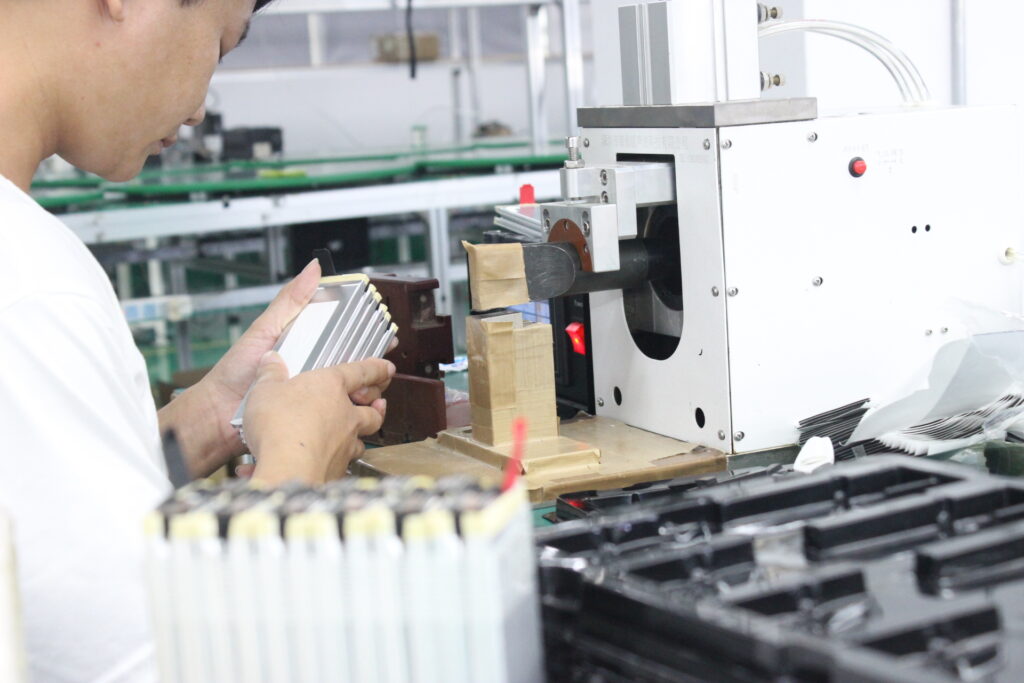
Start with the device and how a person reaches the battery
List where the battery sits, whether a buyer is expected to replace it and what must be moved to reach it. Mark every opening on the installed assembly and identify which parts actually prevent the battery from coming free. A cover can appear secure during a design review while the holder and battery can be reached from another opening once the product is assembled. Review the enclosure, board and battery as installed.
For U.S. consumer products, the Consumer Product Safety Commission provides guidance on Reese’s Law and 16 CFR part 1263. Its guidance describes a secured opening for in-scope replaceable button or coin battery compartments, through use of a tool or independent simultaneous hand actions. Confirm applicability, exceptions and the exact test and labeling requirements for the product with the responsible compliance team.
Compare the two intended service paths
For a replaceable battery, describe the intended opening sequence in plain language and record which components make it work. A hinge, fastener or latch is only as useful as the structure it engages. Look at the tolerance and wear of mating features in the production configuration. Include the battery replacement orientation and any parts the user must reinstall to restore the compartment.
For a battery intended to remain inside the product, capture how the assembly retains the cell during use and how service personnel reach it. Define what happens if a cover, board support or battery holder shifts. In a tabbed or leaded design, the electrical connection and the enclosure restraint have different jobs. Identify which component keeps the cell in place and which component provides continuity.
Bring a complete assembly to the review
A plan based on a bare holder or CAD image misses the assembled access path. Use the production-intent parts and identify cell thickness, the holder revision, all specified fasteners and the assembly sequence. The CR2032 and CR2025 references below are starting points for discussing format. Review the approved part drawing and how it seats in the selected holder before including it on the product configuration.
Jetray’s supplied primary-battery materials discuss tab and wire options for an inquiry. Request the drawing for a proposed connection, then check polarity, clearance and retention against the actual board and enclosure. If a replacement format changes stack height or the contact position, return the installed assembly to the review.
| Review item | Evidence to prepare | Project owner to identify |
|---|---|---|
| Scope and intended user | Product category, destination market and service policy | Regulatory or product owner |
| Opening and retention | Assembly drawing, parts list and open/closed views | Mechanical and assembly engineering |
| Battery and contact | Cell model, terminal drawing, holder and polarity markings | Electrical engineering and procurement |
| Performance and labeling | Applicable test plan, labels, instructions and packaging route | Compliance and quality teams |
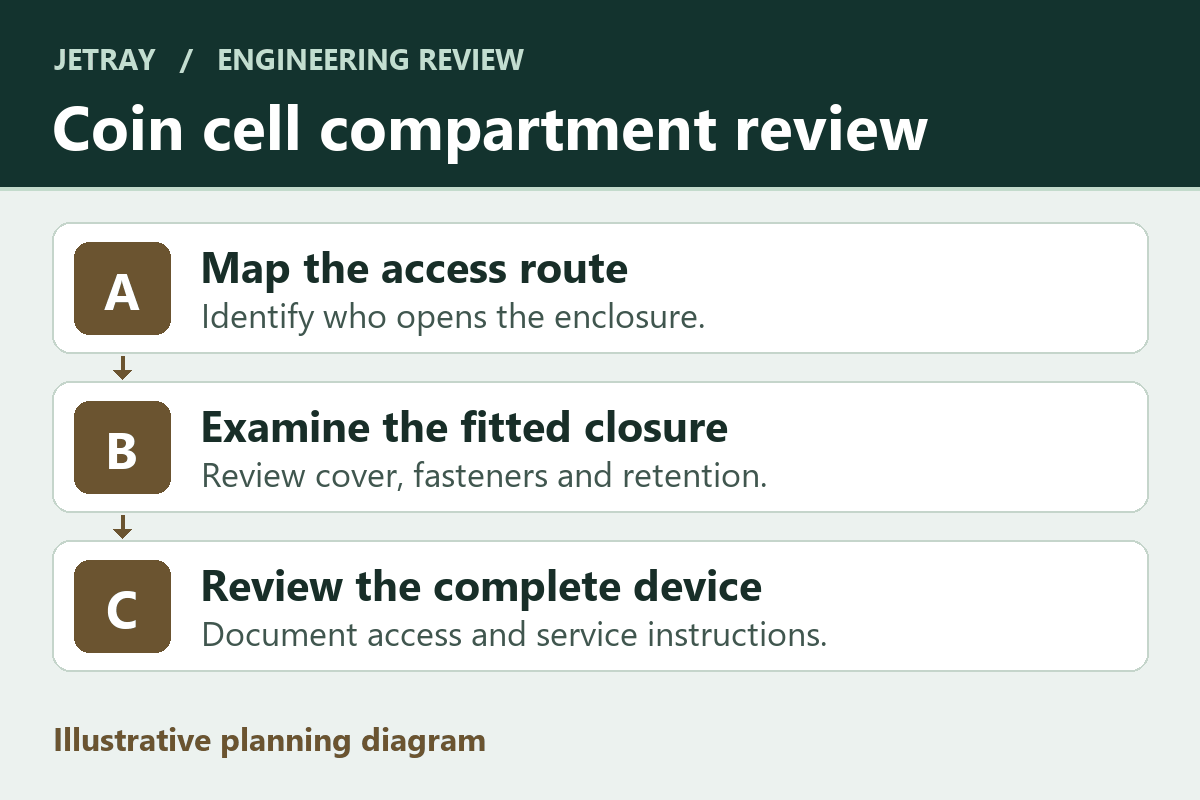
Check labels and packaging against the supply arrangement
Map what goes to the customer with the product. The device, its instructions and a separately packaged battery can create different review tasks. CPSC guidance distinguishes the rule for in-scope consumer products containing or using the batteries from requirements for battery package labeling. A purchase spec should identify whether cells arrive installed, supplied separately in the box or shipped as service parts, so the responsible team can review the appropriate package.
Keep an evidence set for the configuration placed on the market. Record the cell, holder and enclosure revisions, production samples used, destination and the party that owns the applicable documentation. Ask the battery supplier for the format and terminal data it controls. Work with the device team and the appropriate testing organization on the finished product evidence.
Run a service walk-through with the proposed production parts
Give an evaluator the intended service instructions, the closed device and the approved replacement part. Observe where the person puts removed parts, how they see the polarity marking and whether the compartment can be closed in an incomplete state. Keep this walk-through separate from formal performance tests. Its purpose is to catch a confusing instruction, a part that can be omitted or an access path that the mechanical drawing did not make obvious.
If the team changes the design after that review, update the drawing and the service instructions together. A new latch, a thicker battery or an alternative holder can alter how the opening feels and where the cell sits. Record which changes return to the formal review so production does not unknowingly release a different construction.
Coin battery access questions for a design review
Does a captive screw settle the complete review?
Review the full opening path, installed retention, applicable performance checks and marking. The enclosure needs assessment in the production configuration.
Does changing from a holder to tabs remove the review?
Recheck the applicable scope and installed design. A different connection changes the service and retention arrangement and may require different evidence.
What changes should be referred back to compliance?
Refer changes to cell format, enclosure material, hinge, fastener, retaining features and packaging arrangement to the team responsible for the applicable requirements.
Sources & further reading
- U.S. CPSC Button Cell and Coin Battery Business Guidance ↗
- U.S. CPSC Button Cell and Coin Battery FAQs ↗
- Current eCFR 16 CFR part 1263 ↗
- Jetray public explanation of CR2032 and CR2025 formats ↗
- Jetray corporate workspace photo source ↗
Source review 5 November 2026. This is a planning worksheet for product teams. Confirm scope and requirements for the particular product and market.
Prepared for the coin cell batteries collection. General engineering guidance does not replace a model-specific datasheet or application validation. Source review: 5 November 2026.